An AI receptionist for HVAC companies that never misses a no-cooling call
HVAC phones go quiet for weeks and then ring nonstop the first hot weekend. An AI receptionist keeps up with the spike, so you don't lose emergency calls to the next company.
HVAC calls come in waves
An HVAC shop's phone is not steady. Spring is quiet. Then the first heat wave or cold snap hits and every customer calls at once, while your techs are already on jobs. In places like the Phoenix area, a dead air conditioner in July isn't an inconvenience, it's an emergency, and the caller will keep dialing until someone answers.
Hiring for the peak means paying for the slow months too. An AI receptionist scales the other way: it answers the tenth call at the same moment as the first.
Real calls an HVAC receptionist has to handle
Caller: "My AC quit and it's 90 degrees in the house. I have a baby."
What good looks like: the agent stays calm, asks whether the unit is running at all, whether the breaker has tripped, and the address. It recognizes this as urgent, books the earliest emergency slot or transfers the call to your on-call tech, and sends the details to your phone.
Caller: "How much for a tune-up?"
What good looks like: the agent shares the price range you've approved, mentions what's included, and offers a time. It doesn't guess at repair prices; it explains that a technician needs to look at the system, and books that visit.
Caller: "I smell gas near the furnace."
What good looks like: the agent tells the caller to leave the house and contact the gas company or 911, then alerts your team. Safety calls need a firm rule written in before the first call, never improvised.
Caller: "I have a maintenance plan. Can I move my appointment to Thursday?"
What good looks like: the agent finds a Thursday opening and updates the booking, instead of starting from scratch.
What we set up for an HVAC business
- Emergency versus routine rules, so a no-cooling call jumps the line and a quote request doesn't.
- The questions your dispatcher asks: system type, age, symptoms, and whether anyone vulnerable is in the home.
- Service area checks, so you're not booking a job two hours outside your territory.
- After-hours handling that behaves differently at 2 a.m. than at 10 a.m.
- Missed-call text-back, so a caller who hangs up still hears from you.
The seasonal math
Think about your best week of the year and how many calls went unanswered. Each one was a repair or a replacement conversation, and system replacements are the biggest jobs you do. An AI receptionist doesn't make the weather hotter, but it keeps you from handing your busiest days to a competitor who simply picked up.
Tala or a custom build
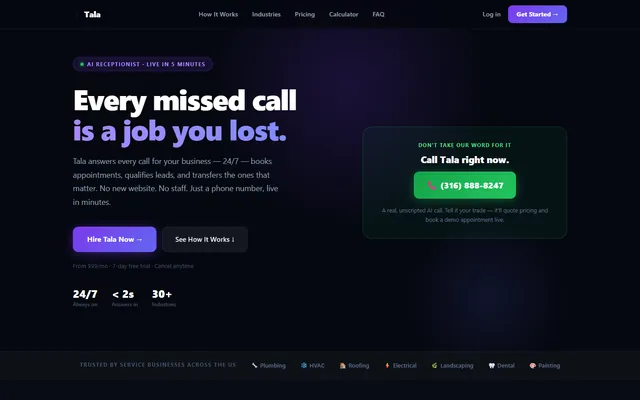
Tala, our AI receptionist, supports HVAC as one of its industries, books into Google Calendar, and transfers urgent calls. If you dispatch through field-service software and want the agent to work with it, we can scope a custom build. Either way, we start with how your calls work today.
Tala
A voice agent that answers every call 24/7, books jobs into the owner's calendar, and transfers the hot ones, with self-serve onboarding, phone provisioning, and a CRM dashboard.
HVAC receptionist questions
Can it tell an emergency from a routine call?
Yes, based on rules you give it: symptoms, weather, who's in the home, and your own definition of urgent. We test those rules on real examples before it goes live.
What about gas smells and carbon monoxide?
Those calls get a fixed safety response written in up front: leave the building and call the gas company or 911, then notify your team. The agent never improvises on safety.
Will it quote repair prices?
Only the ones you approve, such as tune-up pricing or diagnostic fees. For repairs it books a technician instead of guessing.
Does it work in busy season when calls pile up?
That's where it helps most, because it can handle many calls at once.
What does it cost?
The AI audit is free. It's part of our Never Miss a Lead package at $750 a month plus a one-time $3,000 setup, or on its own it's $300 a month plus a one-time $1,200 setup. Setup can be split across your first three months. See all packages, or try Tala yourself at hiretala.ai.
Get your free AI audit.
Tell us about your business. In a 30–45 minute audit we'll show you where you're losing calls, time and money, and which AI agent would pay off first. No obligation.
- Email: ia@1modal.com
- Call or text: (480) 669-0480