Websites for plumbers: built for the call that can't wait
Nobody browses plumbing websites for fun. Your visitor has water where it shouldn't be, or no hot water, and is choosing who to call in the next sixty seconds. Your site has one job.
How does your current site score? Enter the address and get a plain-English report in about a minute: speed, phone-friendliness, how easy it is to call or book you, and what we would fix first. Run the free website check →
What a plumber's website must do
- Get the call in one tap. A tappable phone number at the top of every screen, big enough to hit with a wet thumb. This is the whole site for an emergency visitor.
- Say "now." Same-day, after-hours and emergency availability stated on the homepage, not buried on a services page. If you charge differently after hours, say so plainly.
- Show the service area. Cities and neighborhoods you actually cover, so the right people call and the far-away ones don't waste your dispatcher's time.
- Make non-emergencies easy too. Water heaters, repipes, remodels and inspections are planned purchases. Those visitors want photos, a sense of pricing, and a quote request that doesn't require a phone call.
- Prove you're legitimate. License number, insurance, years in business, real photos of the trucks and crew, and recent reviews. Plumbing is a trust purchase made in a hurry.
- Load fast on a phone. The emergency visitor is on cellular, possibly standing in water. A slow page is a lost job.
What usually goes wrong
Most plumbing sites were built once, years ago, around a desktop layout and a contact form. The phone number is an image or plain text, so it can't be tapped. The homepage opens with a paragraph about the company's history instead of "Call now, we're on the way." Emergency service is mentioned on page three. And the site takes four or five seconds to appear on a phone, which is long enough for the visitor to go back and tap the next result.
How the website and the phones work together
A plumber's website sends calls; the calls still have to be answered. Our AI receptionist for plumbers picks up every call, separates the burst pipe from the slow drain, books the routine jobs into your calendar and transfers the emergencies to your on-call plumber. Missed-call text-back catches the ones that hang up. Quote follow-up chases the water-heater estimate that went quiet, and invoice reminders get you paid without the awkward call. The site is the front door; the agents are the staff behind it.
What we build
A fast, phone-first plumbing site: tap-to-call on every screen, emergency messaging up top, a clear service area, pages for your main services (drains, water heaters, leaks, repipes, remodels), a quote request that works, your license and reviews visible, AI chat ready for the night-time question, and pages written for the searches homeowners in your area actually make. If your current site just needs fixing, the refresh is free with any of our packages; a rebuild is priced below.
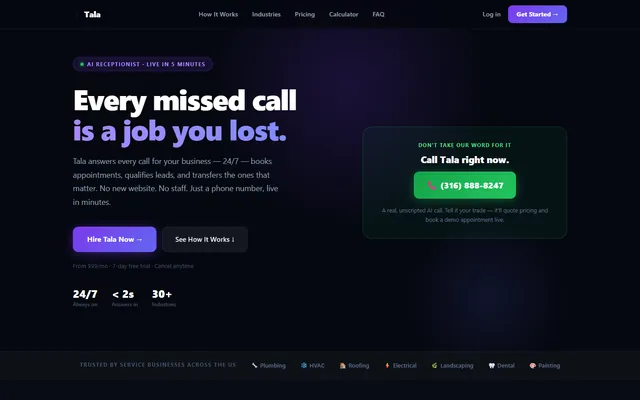
Tala
A voice agent that answers every call 24/7, books jobs into the owner's calendar, and transfers the hot ones, with self-serve onboarding, phone provisioning, and a CRM dashboard.
Website questions from plumbers
Should a plumbing website list prices?
Service-call fees and common flat rates, yes, if you're comfortable with them; it filters out price shoppers and builds trust. Repair prices that depend on the job are better handled by a fast quote process.
Do we need separate pages for each service?
For your main services, yes. A water-heater page and a drain-cleaning page each show up for different searches and answer different questions.
Can the site book jobs directly?
Yes, when connected to your calendar or scheduling software. Emergency calls still go to a human, through the AI receptionist's transfer rules.
How long does a plumbing website take?
Typically a few weeks from the free audit to launch. The free website check shows what your current site is missing first.
Get your free AI audit.
Tell us about your business. In a 30–45 minute audit we'll show you where you're losing calls, time and money, and which AI agent would pay off first. No obligation.
- Email: ia@1modal.com
- Call or text: (480) 669-0480